The Vibe Coding Trap: A Beautiful Website Nobody Can Find
Last updated on May 1, 2026
I’ve been building websites for 30 years. I’ve worked inside agencies, alongside in-house teams, and now I run City of Oaks Marketing, where a growing chunk of my clients are AI companies.
So when I read Dr. Jason Wingard’s Forbes piece, Vibe Coding Will Break Your Company, I didn’t read it like a trend-watcher.
I read it like someone who’s already cleaning up the mess.
What “vibe coding” gets right, and what it gets dangerously wrong
Let’s be honest: the appeal is real.
AI-assisted building collapses the distance between idea and deployment. A marketer can ship a landing page. A founder can ship a product site. A team can “just get something live.”
That speed feels like progress.
But speed without judgment is how companies accidentally ship liabilities.
Wingard nails the core risk:
“Capability is cheap, but judgment is the scarce input.”
– Dr. Jason Wingard, Forbes
That line should be printed and taped to every monitor in every startup.
Because the part that’s getting cheaper isn’t the part that protects your brand.
The stories I keep seeing
I’m not writing this as a theory. I’m writing it as someone who sees the same pattern show up over and over.
1) A lovable website that no one can find, and no one should copy
I’ve watched a company vibe code their own website. It was lovable in the sense that it had personality and it felt “fresh.”
But it wasn’t on brand. It didn’t match their actual positioning, their voice, or the expectations their buyers had when they landed.
And it didn’t follow WCAG standards. Keyboard navigation was inconsistent. Contrast was off. Interactive elements were not labeled correctly. The experience looked fine in a quick demo, but it didn’t hold up under real accessibility testing.
Then the bigger problem showed up. In the process of shipping fast, they effectively deleted their digital presence.
Not because the site was “bad.”
Because it was unreadable.
Uncrawlable.
Unindexable.
Uninterpretable.
Here’s the question I ask in every audit now:
What’s a website for if Google and AI can’t find it, or read it?
Common ways this happens in the real world:
- The site is mostly client-side rendered, so the meaningful content never shows up in the initial HTML.
- Navigation and internal links are inconsistent, broken, or generated in ways crawlers do not reliably follow.
- Headings are styled to look right, but the structure is wrong (or missing), so both humans and machines lose the plot.
- Pages ship without basics like canonicals, clean metadata, or a coherent URL structure.
- Performance is unpredictable, so users bounce and the site never earns trust signals.
2) A vibe coded chatbot that answers questions, but breaks the business
This one is becoming the new “lovable website.” Teams ship a chatbot fast, it demos well, and everyone feels like they just leveled up.
Then reality hits.
Examples I’m seeing:
- The bot confidently answers with outdated or incorrect information because there is no source of truth behind it.
- It cannot cite where answers came from, so support and sales teams cannot trust it.
- It creates legal and brand risk by making promises your company does not actually support.
- It becomes a conversion leak because it cannot route intent properly (pricing, demos, support, enterprise questions).
- It lives in a widget that slows down the site, breaks accessibility, or fails on mobile.
A chatbot is not “done” when it responds. It is done when it is reliable, measurable, and aligned with your actual business rules.
3) A landing page that looks finished, but cannot be measured
Another classic vibe coding outcome is a page that looks great, but:
- Analytics is missing or misconfigured.
- Event tracking is not implemented.
- Forms do not fire conversions.
- UTM handling is inconsistent.
If you cannot measure it, you cannot improve it. And you definitely cannot scale it.
Vibe coding multiplies the failure mode across the whole company
One of the most important points Wingard makes is that vibe coding doesn’t just affect engineering.
It spreads.
Vibe coding dramatically shortens the distance between an idea and the finished artifact, taking it from months down to hours.
“When that distance collapses, every quality-control mechanism your organization developed over the last 30 years gets bypassed by default.”
– Dr. Jason Wingard, Forbes
That’s exactly what I’m seeing.
Not because people are reckless, but because the tools make it feel safe and because the output looks finished.
But “looks finished” is not the same as “works in the real world.”
The hidden cost: you’re not just shipping pages, you’re shipping assumptions
When you vibe code a website, you’re not only generating code.
You’re generating:
- Information architecture
- Content hierarchy
- Accessibility decisions
- Performance tradeoffs
- Tracking and analytics assumptions
- SEO and indexing behavior
- Security posture
- Brand voice and claims
And the scary part is that most of those decisions are invisible to non-technical reviewers.
A page can look perfect and still:
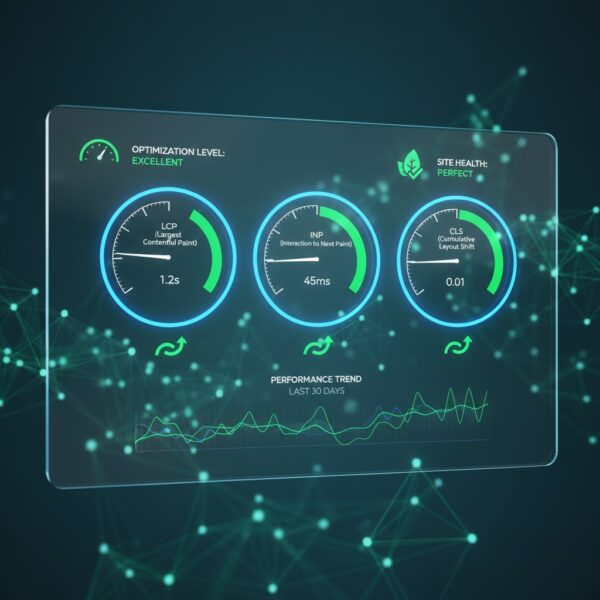
- Fail Core Web Vitals
- Break keyboard navigation
- Hide content behind scripts
- Duplicate titles and meta
- Create thin, repetitive copy
- Produce URL chaos
- Block crawlers with accidental headers
- Ship without canonicalization
That’s not “just a website problem.”
That’s a pipeline problem.
The new reality: your audience includes crawlers and models
For years, we optimized for humans and search engines.
Now we optimize for humans, search engines, and AI systems that summarize, cite, and recommend.
If your site is built in a way that AI systems can’t parse, you don’t just lose rankings.
You lose representation.
You lose the ability to show up in:
- AI Overviews
- Chat-based recommendations
- “Best of” lists
- Comparison prompts
- Vendor shortlists
And if you’re an AI company? That irony is brutal.
What to do instead: keep the speed, add the guardrails
I’m not anti-AI. I use AI constantly.
But if you want the speed of vibe coding without the self-inflicted damage, you need a few non-negotiables.
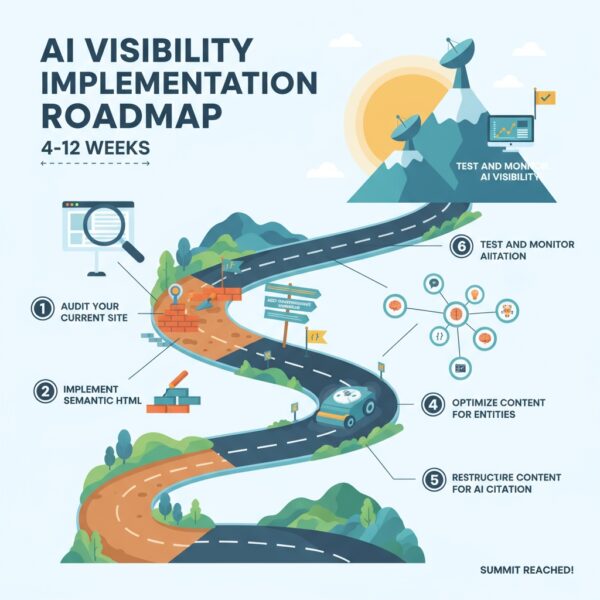
1) Define “done” as crawlable, accessible, and measurable
A page isn’t done when it renders.
It’s done when:
- It ships semantic HTML
- It passes accessibility basics (keyboard, contrast, labels)
- It has a clear heading structure
- It has stable URLs and internal links
- It loads fast enough to keep users (and rankings)
- It’s instrumented (analytics, plus events)
- It’s editable by humans (like your Marketing or SEO teams)
- It’s scalable (trust me, future you will want this)
2) Treat information architecture like product strategy
If your navigation is vibes, your SEO is vibes.
You need:
- Clear service and product taxonomy
- Intent-based pages (not just “cool pages”)
- A content hub strategy
- Internal linking that forms a knowledge graph
3) Add schema like you mean it
If you want AI systems to understand you, you can’t be vague.
Use structured data to define:
- Who you are
- What you do
- What you offer
- What problems you solve
- What proof you have
4) Put a real review process around AI output
Wingard’s warning is ultimately about governance.
If capability is cheap and judgment is scarce, then your process has to protect judgment.
That means:
- Checklists
- QA gates
- Accessibility testing
- Performance budgets
- Security review
- SEO validation
Not because you’re slow.
Because you’re serious.
My take: vibe coding won’t break every company, just the ones that confuse output with outcomes
If you’re reading this and thinking, “We’re moving fast, and it’s working,” great.
But don’t confuse shipping with showing up.
A website that can’t be found can’t sell.
A website that can’t be read can’t be trusted.
A website that can’t be understood can’t be recommended, by humans, Google, or AI.
And that’s why I’m with Wingard on the headline.
Because I’m watching it happen every day.
Credit and source
This article was inspired by Dr. Jason Wingard’s Forbes article: Vibe Coding Will Break Your Company (Forbes, April 23, 2026). Dr. Wingard is a leadership expert and Forbes contributor.

Alison Iddings
Alison Iddings is the owner of City of Oaks Marketing in Raleigh, North Carolina, specializing in custom WordPress development, contextual & technical SEO, and AI Optimization. With 30 years of experience, she helps companies create high-performance custom solutions.