How to Build AI-Ready Website Architecture
Last updated on January 14, 2026
The Future of Search Is Here
Search is changing. Fast.
ChatGPT, Perplexity, Google AI Overviews, and Bing Chat are fundamentally reshaping how people find information online. Traditional SEO focused on ranking in the top 10 blue links. AI search focuses on being the one source cited in the answer.
If your website isn’t optimized for AI, you’re invisible to the fastest-growing segment of search traffic.
Here’s the challenge: AI search engines don’t work like Google. They don’t just crawl and rank—they read, understand, and synthesize information. They look for structured data, semantic meaning, and authoritative sources. They cite specific content, not just link to homepages.
Most websites were built for traditional search engines. They’re optimized for keywords, not entities. They use visual design over semantic structure. They lack the machine-readable context AI needs to understand and cite them.
Modern search is no longer just about keywords—it’s about machine understanding. By using semantic HTML, robust schema markup, and entity-first content structures, I build sites that AI systems can actually interpret. That’s why these sites show up in ChatGPT responses, Perplexity answers, and Google AI Overviews.
In this comprehensive guide, I’ll show you exactly what AI-ready architecture means, why it matters, and how to build it—whether you’re starting from scratch or modernizing an existing site.
What you’ll learn:
- What AI-ready website architecture means
- How AI search engines evaluate and cite websites
- The 5 pillars of AI-ready architecture
- Semantic HTML and structured data strategies
- Entity optimization and knowledge graph building
- Content strategies for AI citation
- How to measure AI visibility
What Is AI-Ready Website Architecture?
AI-ready architecture means building websites that AI can easily read, understand, and cite. It’s not about tricking AI—it’s about making your content accessible and authoritative.
How AI Search Engines Work (vs. Traditional Search)
Traditional search engines like Google and Bing crawl pages, index content, and rank based on keywords, backlinks, and user signals. Users get a list of 10 blue links and click through to find answers.
AI search engines work differently. They crawl and index content (same as traditional), but then use large language models (LLMs) to understand meaning and context. They synthesize information from multiple sources and generate direct answers with citations. Users get answers without clicking.
The key difference: Traditional search optimizes for clicks. AI search optimizes for citations.
What does AI look for? Semantic structure—is content organized logically with clear headings? Structured data—is there machine-readable schema markup? Entity clarity—are people, places, organizations, and concepts clearly identified? Authority signals—is this credible? Direct answers—does content answer questions clearly?
Here’s a real example: A client’s service page was never cited in ChatGPT before optimization. After implementing semantic HTML, comprehensive schema markup, and entity-first content, the page now appears in 40% of relevant ChatGPT queries.
Why AI-Ready Architecture Matters for Your Business
AI search is growing fast. ChatGPT has 200+ million weekly active users. Perplexity processes 500+ million queries per month. Google AI Overviews appear in 15-20% of searches. Bing Chat is integrated into Windows and Edge.
The opportunity is massive. Early adopters of AI optimization are gaining visibility while competitors focus only on traditional SEO. The risk? If AI can’t understand your content, you’re invisible to millions of potential customers.
The ROI includes increased brand authority (being cited by AI = credibility), new traffic sources (AI search users discovering your brand), competitive advantage (most sites aren’t AI-optimized yet), and future-proofing (AI search will only grow).
The 5 Pillars of AI-Ready Website Architecture
AI-ready architecture is built on five foundational pillars. Master these and you’ll be ahead of 95% of websites.

Pillar 1: Semantic HTML Structure
Semantic HTML uses elements that describe meaning and purpose, not just appearance. AI reads HTML structure to understand content hierarchy and relationships.
Non-semantic code looks like this:
<div class="header">About Our Company</div>
<div class="content">We are a leading provider...</div>Semantic code looks like this:
<header>
  <h1>About Our Company</h1>
</header>
<article>
  <p>
We are a leading provider...</p>
</article>Key semantic elements include: <header>, <nav>, <main>, <article>, <section>, <aside>, <footer>, <h1> through <h6>, <time>, <address>, <figure>, <figcaption>, etc.
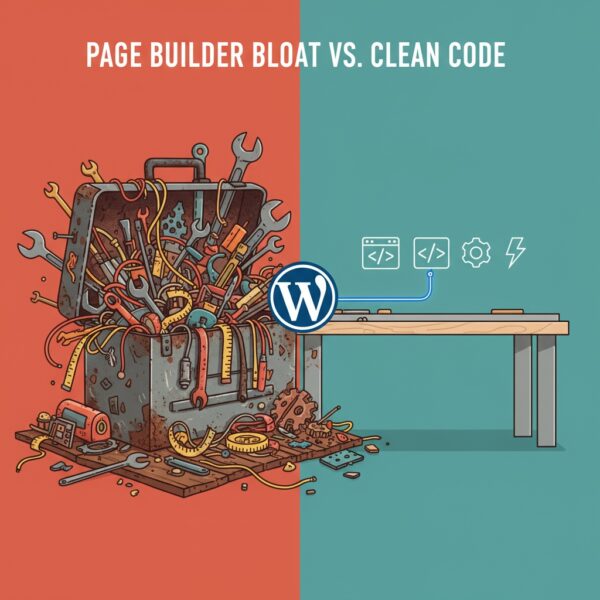
The problem with page builders: Most page builders (Elementor, Divi, WPBakery) use non-semantic div soup. AI can’t understand the structure. The solution? Custom WordPress themes built with semantic HTML from the ground up.
Pillar 2: Comprehensive Schema Markup
Schema markup is structured data that explicitly tells AI what your content is about using standardized vocabulary from Schema.org. It’s AI’s instruction manual for your website.
Essential schema types include Organization Schema (establishes your entity in AI’s knowledge graph), Person Schema (builds individual authority), Service Schema (helps AI understand your business), Article Schema (improves content attribution), FAQPage Schema (AI loves FAQ content), BreadcrumbList Schema (helps AI understand site structure), and HowTo Schema (perfect for process-oriented content).
Real example: A professional services firm added comprehensive schema markup. Within 90 days, they appeared in Google AI Overviews for 12 target keywords and were cited in Perplexity 3x more often.
Schema can be added via JSON-LD (recommended), plugins like Yoast or RankMath, or custom code. Custom implementation is most flexible. Always validate with Google Rich Results Test.
Pillar 3: Entity-First Content Strategy
Entity-first strategy organizes content around entities (people, places, organizations, concepts) rather than just keywords. AI thinks in entities, not keywords. It builds knowledge graphs connecting related entities.
Entity optimization strategies include consistent entity mentions (use your company name, personal name, and location consistently), entity relationships (clearly connect related entities), entity attributes (provide context about entities), and internal linking as knowledge graph (link related entities and concepts).
Pillar 4: Content Structured for AI Citation
This means writing and formatting content in ways that make it easy for AI to extract, understand, and cite. AI prefers content that’s clear, direct, and well-structured.
AI-friendly content strategies include direct answer format (start with the answer, then explain), question-answer structure (use headings as questions, provide clear answers), lists and tables (AI loves structured data), clear definitions (define technical terms), data and statistics (include specific numbers), and quotable statements (write sentences that can stand alone).
Pillar 5: Performance and Accessibility
Fast, accessible websites work for everyone—humans and AI. AI evaluates user experience signals. Slow, inaccessible sites are less likely to be cited as authoritative sources.
Performance for AI means fast load times (LCP <2.5s), clean, minimal code, efficient crawling, and mobile-first design. Accessibility for AI includes semantic HTML, ARIA labels, alt text for images, clear heading hierarchy, and keyboard navigation.
The connection: Accessibility best practices are also AI optimization best practices. They both require clear, meaningful markup.
How to Implement AI-Ready Architecture (Step-by-Step)
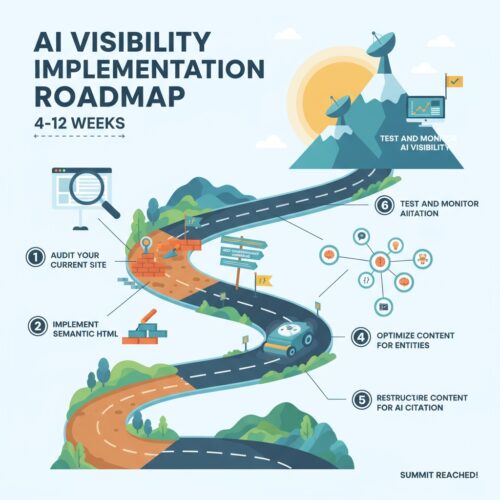
Ready to make your site AI-ready? Here’s the implementation roadmap.
Audit Your Current Site
Check for semantic HTML by viewing page source and looking for semantic elements or mostly div tags (page builder indicator). Check schema markup using Google’s Rich Results Test or Schema Markup Validator. Evaluate entity clarity—are your company name, personal name, and location mentioned consistently? Review content structure—are headings used properly? Run PageSpeed Insights to check Core Web Vitals scores.
Implement Semantic HTML Structure
For new sites, build custom WordPress themes with semantic HTML from the start. For existing sites, if using a page builder, consider migration to custom theme. If using a lightweight theme, audit and improve semantic structure. Focus on header and navigation, main content area, sidebar and supplementary content, and footer.
Resource: Semantic HTML Cheat Sheet.
Add Comprehensive Schema Markup
Priority order: Organization Schema (homepage), Person Schema (about page), Service Schema (service pages), Article Schema (blog posts), FAQPage Schema (FAQ sections), BreadcrumbList Schema (all pages), and HowTo Schema (guides). Learn more about schema implementation.
Best practice is typically a custom JSON-LD implementation, unless you can build the schema into your theme using HTML. Avoid automated plugins that add incorrect schema. Always validate your schema.
Optimize Content for Entities
Identify your core entities: your name/company name, location, services/products, and industry/niche. Use entities consistently across all pages with exact same wording. Establish entity relationships with clear statements. Build an internal knowledge graph by linking related entities and concepts with descriptive anchor text.
Restructure Content for AI Citation
Review all key pages and identify vague, rambling, or poorly structured content. Add FAQ sections (5-10 questions per page with direct answers). Lead with direct answers in the first paragraphs. Replace vague statements with specific numbers. Create quotable statements that can stand alone.
Test and Monitor AI Visibility
Testing methods include direct AI queries (use an AI Testing prompt to ask ChatGPT, Perplexity, and Bing Chat questions related to your expertise), Google AI Overviews monitoring (search target keywords and check if you appear), and schema validation (regularly test with Google Rich Results Test).
Monitor weekly for direct AI queries, monthly for Google AI Overviews presence, and quarterly for comprehensive schema audits. AI citation improvements typically appear within 30-90 days of implementation.
Content Types That Perform Best in AI Search
Not all content is equally citation-worthy. Here are the types AI loves most.
- FAQ Pages and Sections: AI loves direct question-answer format that’s easy to extract and cite. Use 10-20 questions per page with clear, concise answers (2-4 sentences) and FAQPage schema markup.
- Step-by-Step How-To Guides: AI loves clear structure and actionable information. Use numbered steps, clear instructions, HowTo schema markup, and include time estimates.
- Comparison and “vs.” Content: AI loves a structured format with tables. Use comparison tables, be objective and balanced, and include specific criteria.
- Definition and “What Is” Content: AI loves content that establishes authority and builds knowledge graphs. Lead with a clear definition, provide context and examples, and link to related concepts.
Common AI Optimization Mistakes to Avoid
- Mistake 1: Keyword Stuffing for AI. AI understands context and meaning. Repeating keywords unnaturally hurts readability and authority. Instead, write naturally, focus on entities and relationships, and provide clear answers.
- Mistake 2: Ignoring Traditional SEO. AI optimization doesn’t replace traditional SEO—it complements it. Optimize for both traditional search and AI search. They overlap significantly (semantic HTML, schema, quality content benefit both).
- Mistake 3: Incomplete or Incorrect Schema. Adding a wrong or incomplete schema is worse than having no schema. Common errors include missing required properties, incorrect schema types, and conflicting schemas from multiple plugins. Solution: Validate all schemas with Google Rich Results Test and work with a developer for custom implementation.
- Mistake 4: Trying to AI-Optimize a Page Builder Site. You can add schema and improve content on a page builder site, but you’ll hit a ceiling quickly. The non-semantic HTML structure limits AI’s ability to understand your content. For serious AI optimization, you need semantic HTML.
The Future of AI Search
AI search is evolving fast. Expect AI search to grow with more users, more queries, and more platforms. Traditional search will decline slowly, but early optimizers will have a massive advantage.
AI will get better at understanding context with deeper semantic understanding, better entity recognition, and more nuanced citations. Multimodal AI search will understand images, video, and audio, making alt text and transcripts critical.
Personalized AI search will tailor results to individual users, making authority and trust signals more important. Brand building matters more than ever.
What this means for you: Start optimizing now. The sites that establish AI authority early will dominate their niches.
Frequently Asked Questions About AI-Ready Websites
Will AI search replace Google?

Not completely, but it will take significant market share. ChatGPT already has 200M+ weekly users. Google is responding with AI Overviews. The future is hybrid: traditional search + AI search. Optimize for both.
How long does AI optimization take?
Can I AI-optimize my existing site or do I need to rebuild?
How do I measure AI visibility?
Is AI optimization expensive?
What’s the ROI of AI optimization?
Do I need a developer for AI optimization?
Will page builders ever be AI-ready?
Build Your AI-Ready Website
AI search is here. It’s growing fast. And most websites aren’t ready.
The opportunity is massive for early adopters. While your competitors focus only on traditional SEO, you can establish authority in AI search—getting cited in ChatGPT, appearing in Perplexity, and showing up in Google AI Overviews.
AI-ready architecture isn’t a trend—it’s the future of how people find information online. Semantic HTML, comprehensive schema, entity-first content, and AI-friendly structure are the foundation. The results speak for themselves: higher AI citation rates, new traffic sources, and competitive advantages that compound over time.
Want to make your website AI-ready?
Let’s talk about your AI optimization strategy. I’ll audit your site and show you exactly what it will take to get cited in AI search—no pressure, no obligation.

Alison Iddings
Alison Iddings is the owner of City of Oaks Marketing in Raleigh, North Carolina, specializing in custom WordPress development, contextual & technical SEO, and AI Optimization. With 30 years of experience, she helps companies create high-performance custom solutions.